

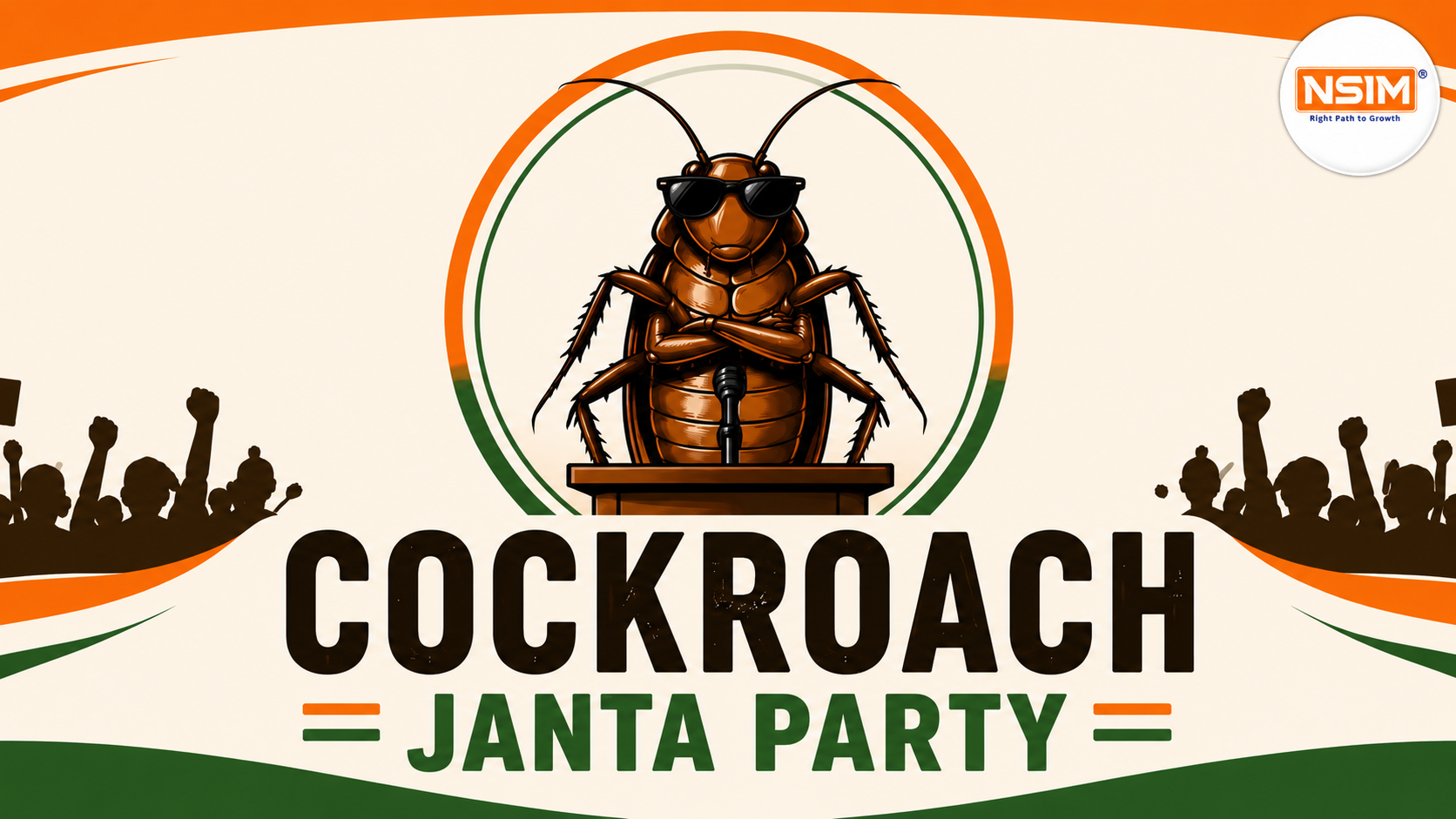
Meme to Movement: The Cockroach Janata Party Viral Marketing Breakdown
I want you to stop and think for a second.
Imagine someone in a position of power publicly compares unemployed youth to cockroaches.
Now imagine that instead of breaking down or getting silent — those same young people look each other in the eye, laugh, and say: "Fine. We ARE cockroaches. And cockroaches survive everything."
That is exactly what happened in India in May 2026.
And it gave birth to one of the most fascinating viral marketing case studies I have seen in a long time — the Cockroach Janata Party, also known as CJP.
Whether you are a digital marketer, a content creator, or a small business owner trying to grow your brand online — this story has lessons that no marketing textbook will ever teach you.
Let's break it all down.
What Is the Cockroach Janata Party?
The Cockroach Janata Party, or CJP, is not a real political party. It is a satirical online youth movement that emerged in mid-May 2026, reportedly as a direct response to a remark that allegedly compared unemployed Indian youth to cockroaches.
Founded by Abhijeet Dipke, the movement describes itself as "secular, socialist, democratic, and lazy" — and proudly calls itself the "Voice of the Lazy and Unemployed."
Within just 48 hours of its launch, CJP reportedly attracted over 40,000 sign-ups. No paid ads. No celebrity endorsements. No marketing budget whatsoever.
Just raw emotion, perfect timing, and an identity that millions of young Indians immediately felt in their bones.
The Spark: How One Insult Became a Movement
Here is something I find deeply fascinating about this story.
Whoever made that remark about unemployed youth being like cockroaches probably thought it would silence people. Shame them. Keep them quiet.
Instead, it did the exact opposite.
It united them.
Abhijeet Dipke and others took that insult — that word meant to belittle — and turned it into a brand identity. They said: yes, call us cockroaches. Cockroaches are resilient. Cockroaches outlive everyone. You can't get rid of us.
That is not just a clever comeback. That is brilliant positioning.
And that is where the first marketing lesson lives.
Lesson 1: The Most Powerful Brands Are Built on Identity, Not Products
CJP did not sell anything. It did not have a product. It did not even have a formal office or party registration.
What it had was an identity — and that identity resonated so deeply with its audience that people rushed to join without being asked twice.
This is something big brands spend crores trying to manufacture. Nike has "Just Do It." Apple has "Think Different." CJP accidentally stumbled into something just as powerful: "We Are the Cockroaches."
For digital marketers, this is a reminder that your brand positioning should answer one question above all:
"Who are my people — and do they see themselves in what I am saying?"
If the answer is yes, you do not need a massive budget. You just need the right words at the right moment.
Lesson 2: Emotion Drives Sharing — Not Information
Let's be honest. Nobody goes viral by being informative alone.
People share things that make them feel something — anger, pride, laughter, belonging, surprise. CJP hit almost every one of these at the same time.
- It made people laugh with its tongue-in-cheek manifesto
- It made people angry because the underlying issues — unemployment, NEET controversies, political defections — are very real
- It made people feel seen and heard because for once, someone was saying exactly what they were thinking
- It created a sense of belonging — suddenly, being unemployed and frustrated was something to joke about together, not be ashamed of
That emotional cocktail? It is almost impossible to manufacture artificially. But when it is real, it spreads faster than any paid campaign ever could.
Lesson 3: Niche Beats Broad Every Single Time
Here is a mistake almost every beginner marketer makes — they try to appeal to everyone.
CJP did the opposite. It spoke directly and specifically to unemployed, online, frustrated Indian youth. It did not try to be diplomatic. It did not water down its message to avoid offending anyone.
It was unapologetically for one specific group of people — and that group responded with overwhelming enthusiasm.
There is a beautiful paradox in marketing: the more specific your audience, the faster your growth.
Because when someone feels like a piece of content or a brand is speaking directly to them — not to the general public, not to "everyone" — they grab it and share it immediately.
CJP's slogans were not designed for middle-aged professionals or retired politicians. They were designed for a 24-year-old engineering graduate sitting at home, updating their resume for the 47th time, wondering when something is going to change.
And that 24-year-old shared it with every single friend they had.
Lesson 4: Meme-Native Content Wins in 2026
The CJP manifesto was not written like a government policy document. It was not a formal press release. It was not even a long article.
It was short, punchy, funny, and built for sharing — the kind of content that looks perfect on a reel, fits in a WhatsApp forward, and works as a screenshot on Instagram.
This is what I mean by meme-native content. It is content that is designed from the ground up to live on social media — not content that was created for a brochure and then awkwardly posted online.
If your brand content still feels like it belongs in a newspaper advertisement from 2010, you are missing the entire conversation happening around you.
Ask yourself: Would someone screenshot this and send it to their best friend?
If the answer is no — rewrite it.
Lesson 5: Your Story Is Your Campaign
This might be the biggest lesson of all.
CJP had no marketing campaign. But it had a story — a clear, emotionally powerful origin story with a villain (the remark), a hero (unemployed youth), and a twist (they turned the insult into their identity).
And that story became the campaign.
Every journalist who covered it was essentially doing free PR. Every person who shared it on social media was a distribution channel. Every meme that got made about it was additional reach.
This is what the best content marketers mean when they talk about narrative-driven branding. The story does the heavy lifting. You just have to make sure the story is good enough to be worth telling.
The CJP story was impossible to ignore.
Lesson 6: Timing a Trend Is Free SEO Traffic
Here is a practical, tactical lesson for bloggers and content creators specifically.
The Cockroach Janata Party became a search trend practically overnight. People were typing it into Google — and there was very little quality content available to answer their questions.
That gap? That is an SEO opportunity.
When a trend is rising and content supply is low, even a relatively new website can rank on the first page of Google by publishing well-written, relevant content quickly.
This is called trend-based content marketing — and CJP is a perfect example of a topic you could have used to drive thousands of organic visitors to your site if you published early.
The lesson: keep your eyes on what is trending in your niche, move fast, and write something genuinely useful. You do not need domain authority of 90 to rank for a brand new keyword.
Lesson 7: Community-First Branding Creates Loyalty No Ad Can Buy
The 40,000 people who signed up for CJP in 48 hours were not customers. They were not subscribers who gave their email for a free PDF.
They were believers. People who felt personally connected to the identity and mission of the movement.
That kind of loyalty — where your audience feels like they belong to something — is the holy grail of branding. It is what separates brands that people forget the moment their ad stops running from brands that people tattoo on their bodies.
Now, obviously not every brand can achieve that level of intensity. But the principle holds at every scale.
Build a community, not just an audience. Speak to people like they matter, because they do. Create something that people are proud to be associated with.
CJP did that with a parody manifesto and a cockroach logo.
Imagine what you could do with an actual product or service you believe in.
What Happened Next: The Movement Grows
Interestingly, CJP did not stand alone for long. Reports indicate that a rival parody group called the National Parasitic Front also emerged — apparently targeting the very politicians CJP was criticizing.
This is fascinating from a marketing perspective too. When a brand identity is strong enough, it does not just attract followers — it attracts competitors and imitators. And that actually validates and amplifies the original movement even further.
By mid-May 2026, CJP had become more than a meme. It had become a cultural conversation about youth frustration, political accountability, and the power of collective identity in the digital age.