
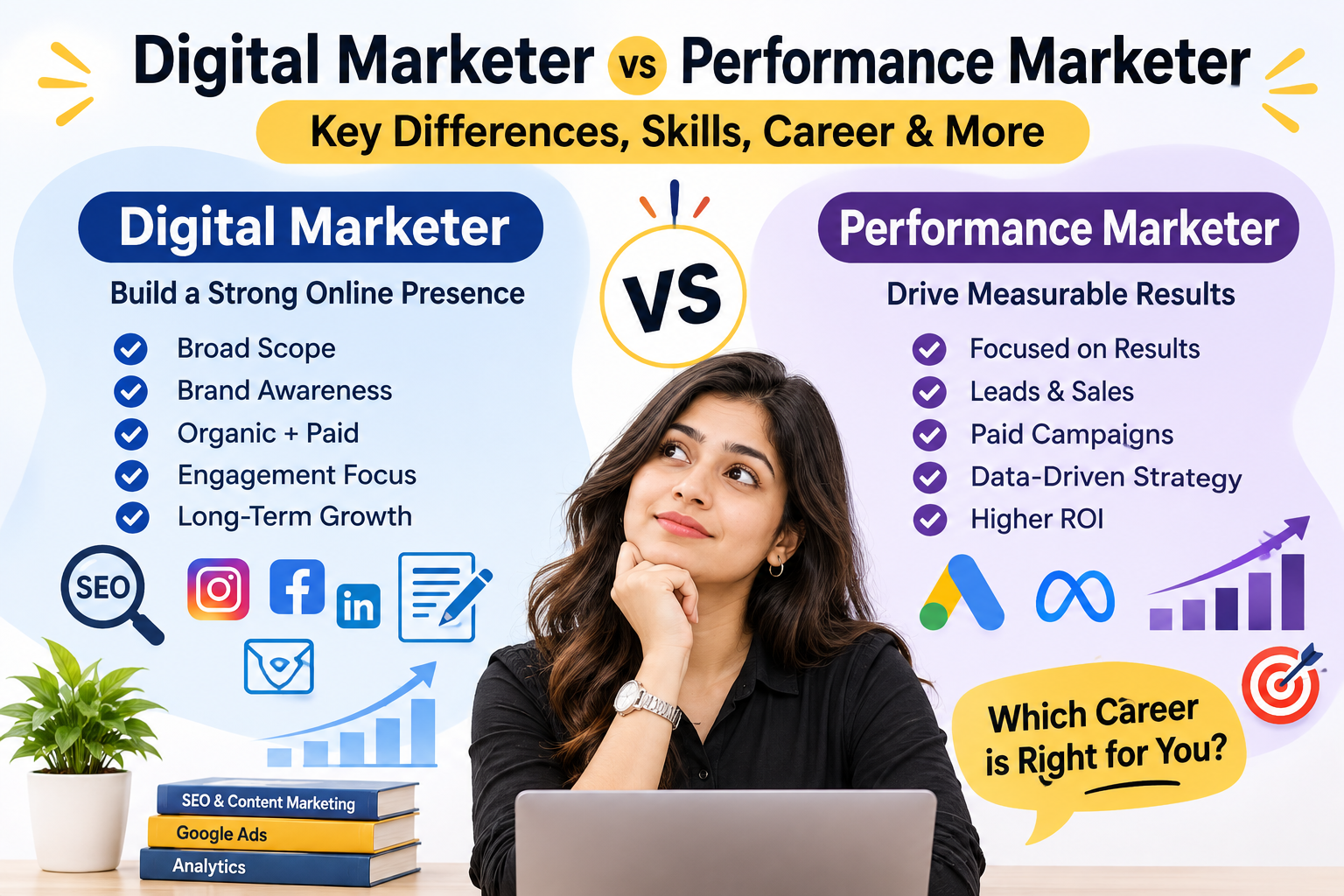
Difference Between Digital Marketer and Performance Marketer
Digital marketing has become one of the most important parts of modern business growth. From building brand awareness on social media to generating qualified leads through Google Ads, businesses depend on online marketing strategies to reach their target audiences. As the industry continues to grow, two professional roles are gaining significant attention: Digital Marketers and Performance Marketers.
Although these two roles are closely connected, their responsibilities, objectives, strategies, and performance measurements are different.
A digital marketer manages a brand's overall online presence across organic and paid channels, whereas a performance marketer focuses on data-driven marketing campaigns tied directly to measurable actions such as clicks, leads, or sales.
1. What Is Digital Marketing?
Digital marketing refers to promoting products, services, or brands through digital channels such as search engines, websites, social media platforms, email, and online advertising.
A digital marketer is responsible for planning, implementing, and managing strategies that improve a brand's online visibility, attract potential customers, and build long-term relationships with its audience.
The role covers both organic and paid marketing activities. This means a digital marketer may work on improving a website's Google rankings, creating social media content, managing email campaigns, and running paid advertisements.
Key Responsibilities of a Digital Marketer
- Search Engine Optimization (SEO): Improving website visibility and organic rankings on search engines.
- Social Media Marketing (SMM): Managing social media accounts, creating content, and increasing audience engagement.
- Content Marketing: Developing blogs, articles, videos, and other valuable content to attract potential customers.
- Email Marketing: Creating newsletters, promotional emails, and automated email campaigns.
- Paid Advertising: Planning and managing advertisements through platforms such as Google Ads and Meta Ads.
- Website Management: Monitoring website performance, user experience, and content updates.
- Analytics and Reporting: Tracking website traffic, engagement, campaign performance, and audience behaviour.
The primary objective of a digital marketer is to establish a strong online presence, improve brand recognition, generate potential customers, and support long-term business growth.
2. What Is Performance Marketing?
Performance marketing is a results-driven approach to digital advertising where marketing activities are measured against specific business objectives.
Unlike broader digital marketing, performance marketing focuses on measurable outcomes. Businesses invest in campaigns to generate actions such as website visits, leads, app installations, product purchases, or registrations.
A performance marketer uses paid advertising platforms, audience targeting, conversion tracking, and data analytics to improve campaign results.
For example, an e-commerce company may invest ₹50,000 in Meta Ads to sell products. The performance marketer monitors how many people clicked the advertisements, how many completed purchases, how much each customer acquisition cost, and how much revenue the campaign generated.
Key Responsibilities of a Performance Marketer
- Paid Advertising Management: Creating and managing campaigns on Google Ads, Meta Ads, LinkedIn Ads, and other advertising platforms.
- Audience Targeting: Identifying potential customers based on demographics, interests, behaviours, and purchase intent.
- Conversion Tracking: Setting up tracking systems to measure leads, sales, registrations, and other actions.
- Campaign Optimization: Improving advertisements, targeting, bidding strategies, and landing pages.
- Budget Management: Allocating advertising budgets to campaigns that generate better results.
- A/B Testing: Testing different ad creatives, headlines, landing pages, and audience segments.
- Performance Analysis: Monitoring CPC, CPA, CPL, conversion rates, and ROAS.
The primary objective of a performance marketer is to generate measurable business results while making the best possible use of the advertising budget.
3. Difference Between Digital Marketer and Performance Marketer
The biggest difference between a digital marketer and a performance marketer is the scope of their responsibilities and the goals they aim to achieve. Digital marketing focuses on building a brand's complete online presence, while performance marketing concentrates on campaigns that deliver measurable results.
| Comparison Factors | Digital Marketer | Performance Marketer |
| Scope | Broad digital marketing activities | Specialized, results-driven marketing |
| Primary Goal | Brand awareness and long-term growth | Leads, sales, and conversions |
| Marketing Approach | Organic and paid | Primarily paid and trackable campaigns |
| Channels | SEO, social media, blogs, email, paid ads | Google Ads, Meta Ads, affiliate networks |
| Main Focus | Online visibility and customer engagement | Measurable business outcomes |
| Key Metrics | Reach, impressions, traffic, engagement | CPC, CPA, CPL, conversion rate, ROAS |
| Tools | GA4, Search Console, WordPress, social media tools | Google Ads, Meta Ads Manager, GA4, GTM |
| Timeframe | Often long-term | Often short- to medium-term campaign results |
A. Scope of Work
Digital Marketer
A digital marketer handles multiple areas of online marketing. Their work may include SEO, social media management, content creation, email marketing, website optimization, and paid advertising.
Performance Marketer
A performance marketer works within a more specialized area. Their primary responsibility is to create and optimize campaigns that generate measurable actions and business outcomes.
B. Primary Goals
Digital Marketer
The primary goal is to increase brand awareness, improve online visibility, build audience relationships, and generate long-term organic growth.
Performance Marketer
The primary goal is to generate leads, sales, registrations, and other measurable conversions while maintaining campaign profitability and efficiency.
C. Marketing Channels and Tools
Digital marketers work across different online platforms and marketing channels, including Google Search and organic search results, Facebook and Instagram, LinkedIn and YouTube, blogs and websites, email marketing platforms, and Google Ads and Meta Ads.
Performance marketers primarily work with advertising and measurement platforms such as Google Ads, Meta Ads Manager, LinkedIn Campaign Manager, Google Analytics 4 (GA4), Google Tag Manager (GTM), affiliate marketing platforms, and conversion tracking and reporting tools.
D. How Success Is Measured
Digital marketers monitor organic website traffic, search engine rankings, social media reach, impressions, audience engagement, website visits, and email open rates.
Performance marketers focus on the following metrics:
- CPC (Cost Per Click): The amount paid for each advertisement click.
- CPA (Cost Per Acquisition): The cost of acquiring a customer or completing a specified action.
- CPL (Cost Per Lead): The amount spent to generate one lead.
- CTR (Click-Through Rate): The percentage of people who click an advertisement after seeing it.
- Conversion Rate: The percentage of users who complete a desired action.
- ROAS (Return on Ad Spend): The revenue generated for every unit of advertising spend.
4. Practical Example: Digital Marketing vs Performance Marketing
Let's understand the difference through a real-world business example. Imagine a company launching a new skincare brand in India.
What will a digital marketer do?
The digital marketer will develop an overall online marketing strategy for the brand. Activities may include:
- Creating and optimizing the brand website.
- Publishing SEO-friendly skincare blogs.
- Managing Instagram and Facebook pages.
- Creating educational skincare content.
- Building brand awareness through influencer collaborations.
- Developing email marketing campaigns.
- Managing paid advertising activities.
The objective is to establish the brand, attract an audience, and build customer trust.
What will a performance marketer do?
The performance marketer will focus on generating measurable sales and leads through advertising campaigns. Activities may include:
- Creating Google Search and Shopping campaigns.
- Running Meta Ads targeting relevant audiences.
- Testing different product advertisements.
- Creating retargeting campaigns for website visitors.
- Monitoring CPC, CPA, and ROAS.
- Optimizing advertising budgets.
- Identifying campaigns that generate the highest number of profitable conversions.
For example, if the company spends ₹50,000 on advertising and generates ₹2,00,000 in tracked revenue, the ROAS is 4x. This means the company generated ₹4 in tracked revenue for every ₹1 spent on advertising.
This example demonstrates how both professionals contribute to the same business goal but approach it differently.
5. Skills Required to Become a Digital Marketer
To become a successful digital marketer, you need a combination of creative, analytical, technical, and communication skills.
- SEO: Understanding keyword research, on-page SEO, technical SEO, link building, and search engine algorithms.
- Social Media Marketing: Knowing how to manage social media platforms, develop content strategies, and engage audiences.
- Content Marketing: Creating blogs, website content, social media posts, and other marketing materials.
- Google Ads: Understanding search, display, video, and other advertising campaign formats.
- Analytics: Analysing website traffic, user behaviour, and marketing performance using GA4 and Google Search Console.
- Communication Skills: Writing effective marketing content and communicating with clients, teams, and customers.
- AI and Marketing Automation: Using AI tools and automation platforms to improve content planning, research, reporting, and marketing productivity.
6. Skills Required to Become a Performance Marketer
Performance marketing requires a stronger focus on numbers, advertising strategies, and campaign optimization.
- Paid Advertising: Practical knowledge of Google Ads, Meta Ads, LinkedIn Ads, and other paid advertising platforms.
- Audience Targeting: Understanding demographics, interests, online behaviour, and customer purchase intent.
- Conversion Tracking: Knowledge of Google Tag Manager, GA4 events, Meta Pixel, and conversion tracking.
- Data Analysis: Analysing campaign reports to identify opportunities for improving advertising performance.
- Budget Optimization: Managing advertising budgets and allocating spending to campaigns that achieve business objectives.
- A/B Testing: Testing different creatives, headlines, landing pages, and audience groups to identify better-performing combinations.
- ROI and ROAS Analysis: Understanding campaign profitability, customer acquisition costs, and advertising returns.
7. Career Opportunities: Digital Marketing vs Performance Marketing
Both career paths offer opportunities across different industries, including e-commerce, education, healthcare, real estate, hospitality, IT, and digital marketing agencies.
Digital Marketing Career Opportunities
- Digital Marketing Executive
- SEO Executive
- Social Media Manager
- Content Marketing Specialist
- Digital Marketing Manager
- SEO Manager
- Marketing Strategist
- Growth Marketing Specialist
Performance Marketing Career Opportunities
- Performance Marketing Executive
- PPC Specialist
- Google Ads Specialist
- Meta Ads Specialist
- Paid Media Manager
- Performance Marketing Manager
- Growth Marketing Manager
- Acquisition Marketing Specialist
With experience, professionals in both fields can move into managerial, strategic, and leadership positions.
8. Digital Marketer vs Performance Marketer: Salary in India
Salary depends on experience, technical expertise, company size, location, industry, and campaign management responsibilities. Performance marketers with strong paid advertising and conversion optimization skills may earn competitive salaries because their work is closely connected to measurable business results. However, experienced digital marketing professionals with strong strategic and managerial skills can also command high salaries.
The following figures are broad illustrative salary ranges in India, not guaranteed industry averages.
| Experience | Digital Marketer | Performance Marketer |
| Fresher (0–1 year) | ₹2–3.5 LPA | ₹2.5–4 LPA |
| 1–3 years | ₹3–6 LPA | ₹4–7 LPA |
| 3–5 years | ₹5–9 LPA | ₹6–12 LPA |
| 5+ years | ₹8–15+ LPA | ₹10–18+ LPA |
Professionals with expertise in Google Ads, Meta Ads, GA4, conversion tracking, SEO, and marketing strategy may have additional opportunities for career growth.
9. Which Career Should You Choose?
Choosing between digital marketing and performance marketing depends on your interests, strengths, and professional goals.
Choose Digital Marketing If:
- You enjoy content creation and brand building.
- You are interested in SEO and social media marketing.
- You like working across different marketing channels.
- You enjoy understanding customer behaviour.
- You want to develop a broad understanding of online marketing.
Choose Performance Marketing If:
- You enjoy working with numbers and analytics.
- You are interested in paid advertising.
- You like experimenting with different advertising strategies.
- You enjoy optimizing campaigns and managing budgets.
- You want to work towards measurable business targets.
Can You Learn Both?
Absolutely! Understanding both digital marketing and performance marketing can make you a more versatile marketing professional. A digital marketer who understands performance advertising can develop more effective marketing strategies. Similarly, a performance marketer with knowledge of SEO, content, and customer behaviour can create better advertising campaigns.
Businesses increasingly value professionals who can understand the complete customer journey, from discovering a brand to making a purchase.
Conclusion
Digital marketing and performance marketing are two closely connected but different areas of the marketing industry.
A digital marketer focuses on building a brand's overall online presence through SEO, social media, content marketing, email marketing, and paid advertising. A performance marketer specializes in measurable advertising campaigns that generate leads, sales, and conversions.
Neither career is universally better than the other. Both offer excellent career opportunities, provided you develop the right skills and gain practical experience.
If you are starting your career in digital marketing, learning the fundamentals of SEO, social media, content marketing, Google Ads, Meta Ads, and analytics will give you a strong foundation. You can then specialize in performance marketing as you gain experience and discover your interests.
The most valuable marketing professionals are those who understand both brand growth and measurable business performance.